
How to turn the customisability of a technical product into a selling point | 3D video

A technical product may have features that are very appealing to the customer, but these are not always immediately apparent when looking at the finished product.
This is the case with a manifold that can be customised to suit the specific system: the number of outlets, different connection types and internal operation are all key selling points.
The challenge is to convey these in a matter of seconds, without forcing the customer to interpret them through technical data sheets, drawings or lengthy explanations.
This is where 3D video can become a valuable tool to support marketing and sales.
The challenge
The client needed to present a product that was not designed as a single, standardised solution, but could be configured to suit different installation requirements.
It was therefore necessary to make several aspects immediately clear:
the option to manufacture the manifold with different numbers of outlets;
the various connection solutions available;
the system’s modularity;
the assembly principle;
the flow of water within the manifold;
the advantages of the solution compared to traditional systems.
This technical information needed to be transformed into a simple, visual and commercially viable narrative.

The solution
We used 3D technology to break down the product, showcase its configurations and reveal what is normally hidden inside it.
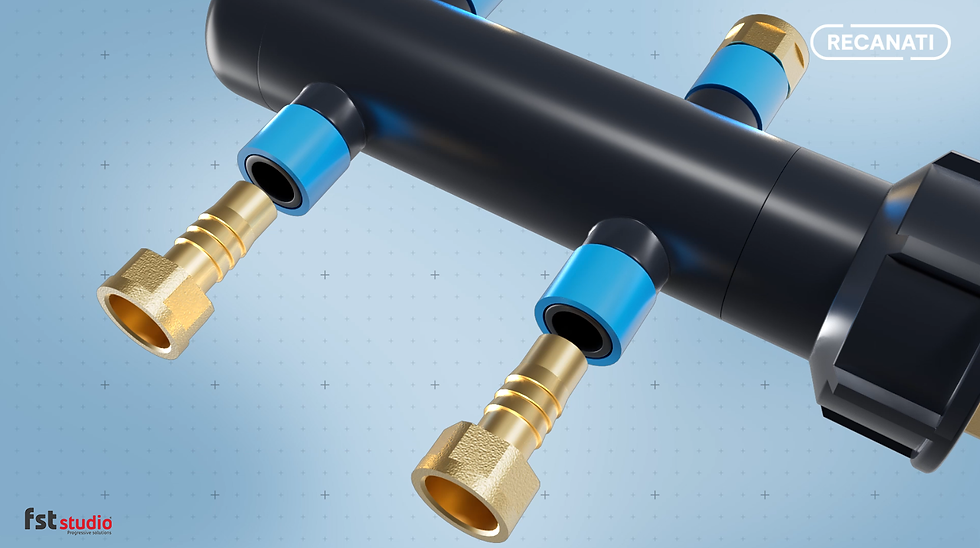
The animation allows us to separate the manifold body, fittings and components, visually demonstrating how the configuration is assembled.
The same approach then allows us to present different lengths and numbers of outlets, making it immediately clear that the product can be adapted to different system requirements.
Instead of simply writing: ‘The product is customisable’, we can show the customisation process as it happens.
And this is precisely the difference between describing a technical feature and turning it into a selling point.
From technical feature to commercial benefit
Stating that a manifold can be manufactured in different configurations is simply a piece of information.
Visually demonstrating a manifold transitioning from a compact configuration to solutions with 4, 6, 8, 10 or 12 outlets, on the other hand, allows the potential customer to immediately visualise the product within their own application.
The same principle applies to different connection types.
Through exploded views, close-ups and assembly animations, it is possible to focus attention on individual components and explain the available alternatives without overloading the communication with technical information.
A feature becomes easier to sell when the customer can visualise the benefit it offers.
Making visible what is not normally seen
Then there is information that is even more difficult to convey through traditional photographs or video footage: what happens inside the product.
Through a virtual cross-section of the manifold, we have made the water’s path visible, showing the flow within the main body and its distribution to the various outlets.
In the material produced, this visualisation is also used to reinforce the message regarding corrosion resistance, the absence of lead and the reduction in maintenance costs.
3D technology therefore allows us to move from the exterior to the interior of the product without interrupting the narrative.
The hidden inner workings become part of the marketing message.

Where it can be used
Content of this kind can support various stages of corporate communication: sales presentations and video calls, new product launches, trade fairs and events, websites and product pages, sales force presentations, technical and sales training, social media, digital campaigns, and meetings with designers, installers and distributors.
The same 3D model can also be reused to create renderings, exploded views, cross-sections, technical details, different configurations and new animations, whilst maintaining visual consistency across all content.
The benefits
For marketing, it means being able to communicate technical specifications through much more immediate images.
For the sales team, it means having a visual tool with which to explain configurations, connections and benefits during a presentation.
For the customer, it means understanding more quickly which configuration best meets their needs.
For the company, it means transforming a single 3D model into a reusable asset for videos, images, presentations, trade fairs, training and digital communication.
The product remains the same.
What changes is the ability to convey its value.

Behind the solution: 3D verification + AI
AI can now speed up certain stages of visual production and vastly expand creative possibilities.
But when the content is intended to sell a real technical product, consistency is non-negotiable.
Dimensions, geometries, the number of outlets, connections, materials and the positions of components must remain verifiable.
If we need to show three different connections, they must be the correct ones.
If we create an exploded view, every component must maintain a consistent shape and position.
If we show the inner workings, the animation must be deliberately designed to explain that specific concept.
This is why, at FST 3D, we integrate the capabilities offered by artificial intelligence into a process based on the control of technical visualisation.
AI + Technical supervision
Consistent product – Controlled geometries – Stable materials – Bespoke animations – Replicable content
AI can speed up the process.
3D keeps control of the product.
Services involved
3D modelling: Reconstruction of the product and its individual components.
Product rendering: Images for marketing, catalogues, websites and presentations.
3D technical animation: Exploded views, assemblies, configurations and movements designed to explain specific features.
Flow visualisation: Cross-sections and animations to illustrate the product’s internal workings.
3D + supervised AI: Integration of AI at stages where it can increase speed and creative possibilities, whilst maintaining control over the technical product.
Do you have a configurable product that’s difficult to explain?
If your product’s dimensions, components, accessories, connections or configuration can vary according to the customer’s needs, we can transform these variables into visual content designed for marketing and sales.
We start with CAD files, technical drawings or product documentation and craft a narrative that shows not only how it’s made, but how it can be configured, how it works and why it might be the right solution for the customer.
We don’t just create 3D images: we turn technical specifications into selling points.


